

Venezuela shifts toward compliant trade channels
Venezuela remained a central theme throughout January, with the narrative shifting as crude exports began moving back into compliant trade channels under US oversight. Licensed traders have started routing Venezuelan barrels openly toward the United States and Caribbean, marking a structural change in how these volumes are marketed and transported. While near-term trade patterns remain fluid, this transition is already supporting employment for Aframax and Suezmax tonnage and is expected to increase tonne-mile demand as volumes scale and trade routes normalise.
Sanctions enforcement reshapes trade flows beyond headline volumes
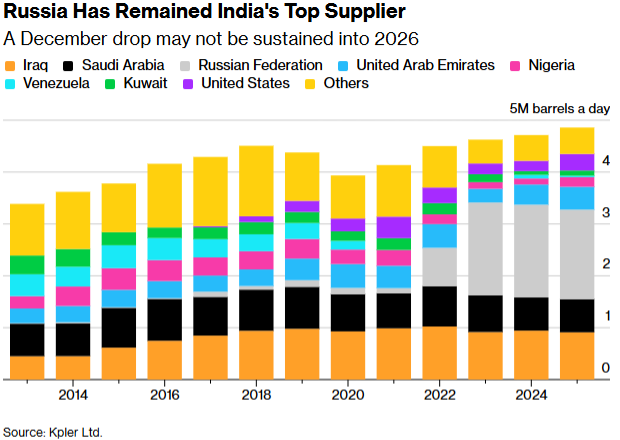
January highlighted how sanctions enforcement, rather than new sanctions, is increasingly driving trade reallocation. Renewed pressure on Russian crude has contributed to some decline in Indian imports, with refiners incrementally increasing purchases of longer-haul mainstream supply, deepening the role of the Americas in Asian crude trade. At the same time, Russian crude exports to India have proven more resilient than many expected, as refiners continue to prioritise pricing and margins, slowing the pace at which sanctioned barrels are replaced by compliant supply. These shifts have not disrupted global balances but have increased voyage distances and added a higher geopolitical risk premium in freight markets. Tanker markets have so far proven resilient, benefiting from longer routing patterns and sustained tonne-mile demand even in the absence of outright supply shocks.
Iran risk skews sentiment despite stable reported production
Geopolitical risk surrounding Iran intensified during the month following widespread domestic protests driven by severe economic stress, including high inflation and currency weakness, which prompted a forceful government crackdown and raised questions around internal stability. Iran is currently producing close to 5 million barrels per day of crude and other petroleum liquids, near multi-decade highs, but exports remain vulnerable to both external policy pressure and internal disruption. US rhetoric, including tariff threats and the deployment of naval assets to the region, kept military risk in focus, while unrest underscored the fragility of Iran’s production base. Historically, labour unrest rather than external attacks has posed the greatest risk to Iranian oil output, making this a low-probability but high-impact scenario for global crude supply.
Routing risks and security disruptions continue to support tonne-miles
Beyond country-specific developments, broader regional risks continued to influence shipping markets. Red Sea transits recovered only gradually and remained below pre-disruption levels, sustaining longer routing patterns and supporting tonne-mile demand across energy shipping segments. Elevated Panama Canal costs further reinforced inefficient routing, particularly for energy and gas trades. A full normalisation of key chokepoints would reduce tonne-miles across several segments, though tanker markets are expected to be less exposed than dry bulk or container shipping.
Sources: Bloomberg, Fearnleys, Reuters, S&P Global & TradeWinds