

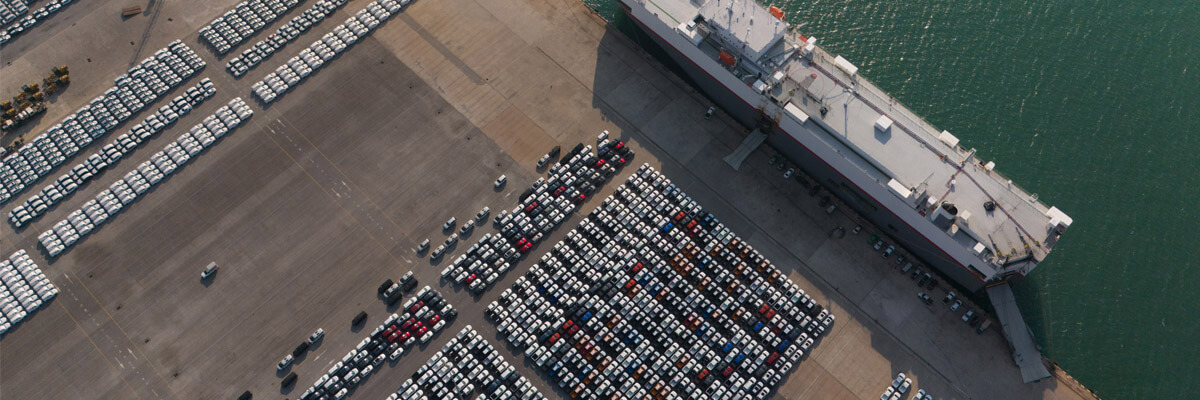
Record newbuilding deliveries were expected to tip car carriers into oversupply, but surging Chinese exports and accelerating European BEV adoption have so far absorbed the incoming tonnage
Export growth and EV momentum defy the bearish consensus
The PCTC market entered 2026 under a cloud: a large orderbook, rising tariff threats, and predictions of softening rates. What has materialised instead is a market where demand has largely matched supply. Chinese vehicle exports reached roughly 8.3 million units in 2025, up more than 30% year-on-year, with electric vehicle exports rising close to 70%. Wallenius Wilhelmsen CEO Lasse Kristoffersen noted that this surge has effectively “sold out” the PCTC fleet despite record newbuilding deliveries. On the demand side, the European market is strengthening: new EU car registrations totalled 3.79 million units in the January–April 2026 period, up 4.2% year-on-year, with April alone reaching 972,000 units, up 5.1%. Battery-electric vehicles now represent 19.7% of the EU market year-to-date, up from 15.3% a year earlier, with particularly strong growth in Italy (+73.1%), France (+48.2%), and Germany (+41.3%). Chinese OEMs are gaining ground rapidly: BYD registered 71,863 units in the period, up 152.9% year-on-year, and Chery Automobile recorded 48,364 units, up 267.1%.
The balance tips on tariffs and fleet growth
Clarksons forecasts PCTC fleet growth of 8% in 2026 against demand growth of just 1–2%, meaning the margin for error is thin. The risk within the segment lies in the intersection of supply growth and trade policy: EU tariffs on Chinese electric vehicles could slow China-to-Europe shipments, while broader US tariff escalation introduces uncertainty on transpacific lanes. As Electric Vehicle penetration deepens and Chinese export flows into Europe remain robust, the demand backdrop for car carrier capacity on the Asia–Europe trade stays constructive, though the loss of Middle Eastern volumes remains a headwind for utilisation. If tariffs increase and export growth decelerates, the wave of newbuildings could tip the balance toward oversupply in early 2027. However, the PCTC segment in its currently state is structurally strong supported by high utilization and strong EV demand.
Sources: ACEA, Automotive Logistics, Clarksons Research, China Passenger Car Association, Fearnley Securities, Marklines, VesselsValue, Wallenius Wilhelmsen, WorldCargo News