

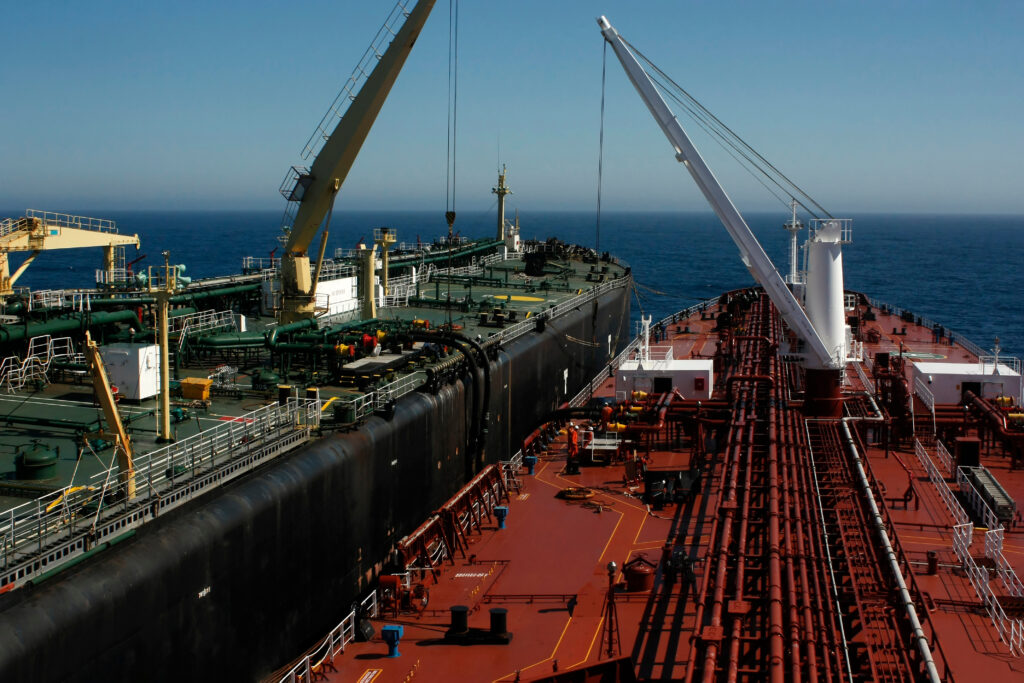
Ship-to-ship transfers outside Hormuz and tighter Panama Canal capacity continue to absorb vessels and support charter rates.
Tankers: VLCC earnings exceed $1 million per day, pulling Suezmax and Aframax rates higher
Tanker markets strengthened again last week, with benchmark VLCC earnings from the Middle East Gulf to China rising above $1 million per day. A key reason is the increasingly complex way crude is moving out of the Gulf. Producers are using VLCCs to carry oil through the Strait of Hormuz to the Gulf of Oman, where cargoes are transferred to other tankers for the onward voyage. In practice, this means that a single cargo can now require two ships instead of one.
That additional vessel demand is tightening availability across the tanker market. With fewer VLCCs available for traditional trades, charterers are increasingly splitting cargoes onto Suezmaxes and Aframaxes. One-year timecharter rates have consequently risen to around $130,000/day for Suezmaxes and $75,000/day for Aframaxes, compared with 2025 averages below $40,000/day. BRS Shipbrokers expects parts of this shuttle system to remain even after Hormuz fully reopens, which could provide more lasting support to period demand.
LPG/VLGC: One-year rates rise to more than twice 2025 levels as vessel supply tightens
The VLGC market also strengthened last week, with earnings on the US Gulf to Japan route rising 17% to around $190,000/day, close to the record levels seen in May. Strong US export economics remain supportive, as the price gap between US and Asian LPG continues to encourage long-haul trade, while vessel availability in the US Gulf remains limited.
This tightness is increasingly visible in the period market. One-year timecharter rates for modern VLGCs have risen to around $90,000/day, more than twice the 2025 average. Attention is also turning to the Panama Canal, where transits are currently capped at 32 per day. If a strong El Niño results in tighter restrictions, more US-Asia cargoes could be routed around the Cape of Good Hope, extending voyages and absorbing additional vessel capacity.
PCTC: Timecharter rates remain around $85,000/day, well above 2025 levels
Car carrier rates remain firm, with six to 12-month timecharters for a 6,500 CEU vessel holding at around $85,000/day. This is up from approximately $70,000/day in June and remains well above the 2025 average.
Unlike some other shipping segments, PCTCs appear relatively less exposed to tighter Panama Canal restrictions. Car carrier transits fell by only around 8% during the 2023/24 El Niño period. Instead, the main factor to watch is future vessel supply. The orderbook now represents roughly 20% of the existing fleet, with 88 car and ro-ro carriers ordered so far this year compared with 17 in 2025. Most of these vessels will not arrive until 2027 and beyond, however, leaving near-term fleet growth relatively contained.
Geopolitics: Hormuz oil flows reach a six-month high despite renewed attacks on Saudi Arabia
Oil movements through the Strait of Hormuz have continued to recover. US Central Command reports that shipments reached a six-month high in recent weeks, supported by mine clearance and US naval protection. Even with this improvement, around one-third of Middle East crude exports remain offline, meaning the region is still operating well below normal capacity.
At the same time, pressure has shifted toward Saudi Arabia’s alternative export routes. Drone attacks shut the East-West pipeline to the Red Sea on 10 September, while Houthi attacks on Saudi targets have intensified. Attention is now turning to diplomacy, with the US and Iranian presidents potentially meeting during the UN General Assembly in New York. Progress toward de-escalation could gradually reduce risk premiums, while continued disruption would keep more VLCCs tied up in the current Hormuz shuttle system.
Sources: Bloomberg, BRS Shipbrokers, Clarksons Research & MB Shipbrokers