

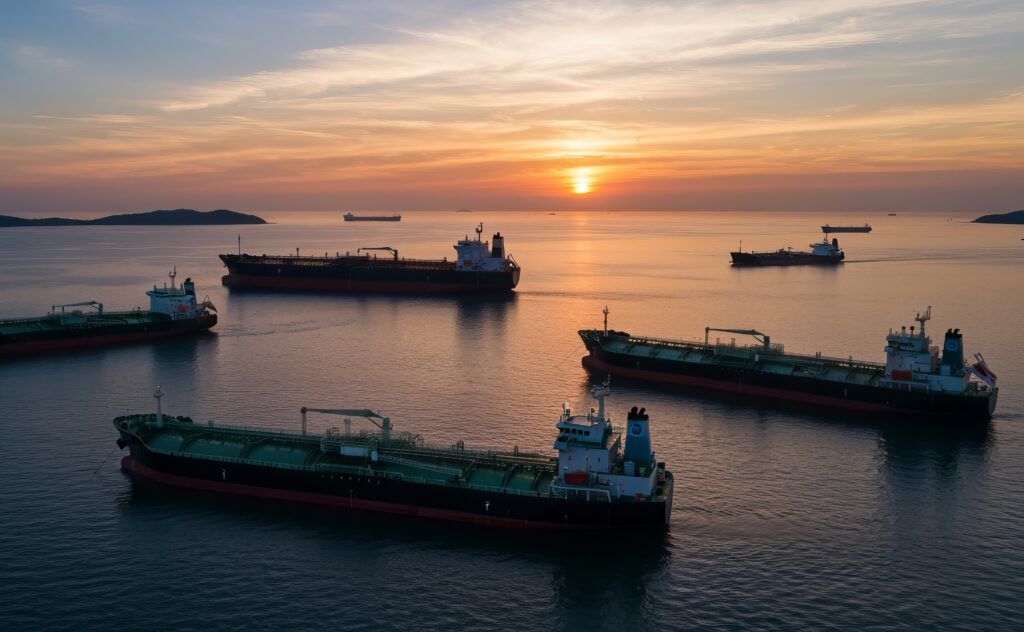
Record tanker rates are emerging despite falling oil trade, suggesting that today’s market is being driven by disrupted supply chains rather than demand growth.
Today’s strength is coming from inefficiency, not rising oil demand
It is tempting to compare today’s tanker market with the last major supercycle in 2007-08, particularly as spot rates move to levels not seen in years. But the forces behind the two markets are very different. BRS Shipbrokers points out that the previous boom was largely driven by rapid growth in Chinese oil demand. Today, the opposite is true: Clarksons expects seaborne crude trade to decline by around 7% this year.
What has changed instead is the amount of shipping capacity required to move each barrel. Gulf producers are increasingly using VLCCs to transport crude through the Strait of Hormuz to the Gulf of Oman, where the cargo is transferred to another tanker for the onward journey. A voyage that would normally require one vessel can therefore involve two. This has removed a significant number of VLCCs from the wider market and pushed benchmark earnings above $1 million per day last week. With VLCC availability increasingly limited, charterers are turning to Suezmaxes and Aframaxes, helping lift average earnings to around $375,000/day and $185,000/day respectively.
The bigger question is how much of today’s disruption becomes permanent
BRS Shipbrokers believes parts of this two-stage shuttle network could remain even after traffic through Hormuz normalises. The system already absorbs around 15% of mainstream VLCC tonnage, so even partial continuation would leave the effective supply of vessels tighter than headline fleet numbers suggest.
The wider fleet is also more constrained than it first appears. Around 200 VLCCs operate in sanctioned trades outside the mainstream market and now primarily carry Iranian oil, making them largely unavailable to conventional charterers. At the same time, BRS expects eventual stock rebuilding following the Hormuz disruption to generate additional cargo demand, potentially exceeding 1.7 billion barrels across 2027-28.
The strength is already visible beyond the spot market. One-year timecharters are around $175,000/day for VLCCs, $130,000/day for Suezmaxes and $75,000/day for Aframaxes. Asset values have followed, with a five-year-old VLCC now valued at approximately $169 million, above the roughly $131 million cost of a newbuilding. The main counterweight is the orderbook, although most new VLCC and Suezmax deliveries are not expected until 2028 and beyond.
Sources: BRS Shipbrokers & Clarksons Research