

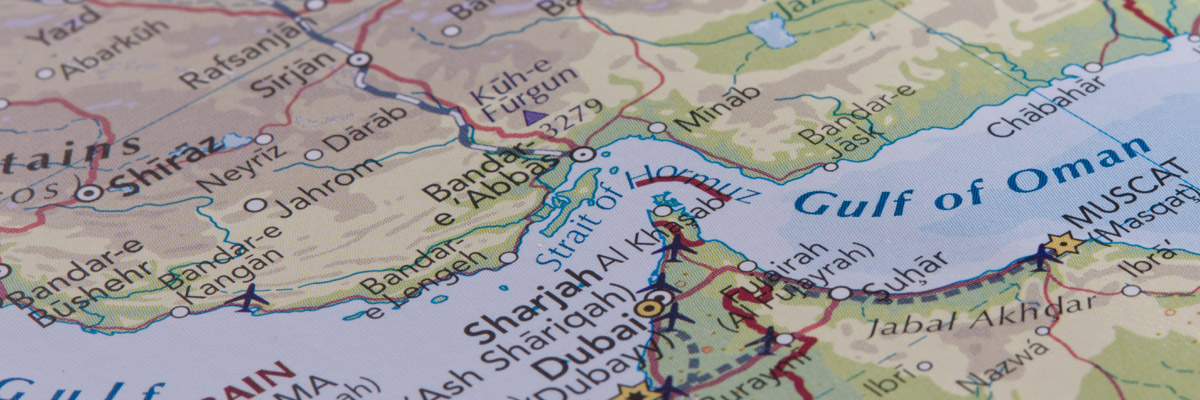
The Strait of Hormuz has returned to full crisis conditions, Houthi forces have widened their campaign to Saudi ports, and EU sanctions enforcement has intensified
From de-escalation to renewed disruption
July opened with cautious optimism after the June Islamabad Memorandum established a temporary ceasefire between the United States and Iran. Shipping traffic through Hormuz was slowly rebuilding, crude flows from the Gulf had partially recovered, and oil prices had eased. Within weeks, the agreement had collapsed entirely. Iran resumed attacks on commercial shipping, the United States struck Iranian military and port infrastructure and reimposed its blockade, and both sides declared the ceasefire over. An Iranian missile attack on a US base in Jordan killed two American service members, prompting further US strikes reaching port infrastructure. By late July, vessel transits through the strait had fallen back to roughly 95 percent below normal levels, roughly 410 ships remained stranded, and approximately 6,000 seafarers were still in the Gulf.
Houthi embargo and EU sanctions broaden the risk picture
The disruption is no longer confined to a single chokepoint. Iran-backed Houthi forces announced a maritime embargo on Saudi Arabian ports, threatening the Yanbu Red Sea export route that Saudi Arabia has relied on to bypass Hormuz since the closure began. Early data points suggest a reduction in vessels transiting the Suez canal through the Red Sea. In the Black Sea, oil loadings at the CPC terminal at Novorossiysk have been suspended following attacks, with Kazakhstan reducing production. The EU’s 21st Russia sanctions package, adopted on July 23, marks a significant escalation in enforcement: for the first time, member states are authorised to confiscate and sell oil cargoes carried by intercepted shadow fleet vessels, and the package targets the supply ships that refuel sanctioned tankers at sea.
Diplomacy is the decisive variable heading into August
The US agreed to pause strikes on Iran on July 27 to allow more time for negotiations, and an Oman-mediated channel remains active. The speed of the original June ceasefire shows that de-escalation can move quickly when both sides have incentive. Should talks produce results, the strait could reopen and freight markets could normalise rapidly. Should they fail, the combination of sustained Hormuz closure, Houthi disruption in the Red Sea, and suspended Black Sea loadings would represent the most severe simultaneous disruption to global energy shipping routes since the crisis began in February. For shipping markets, there are a range of potential outcomes, all of which would be supportive for shipowners via either increasing tonnes miles through vessel rerouting, higher charter rates or increased vessel utilisation.
Sources: Clarksons Research, CNN, EU Council, Lloyd’s List Intelligence, Reuters & Straits.live