

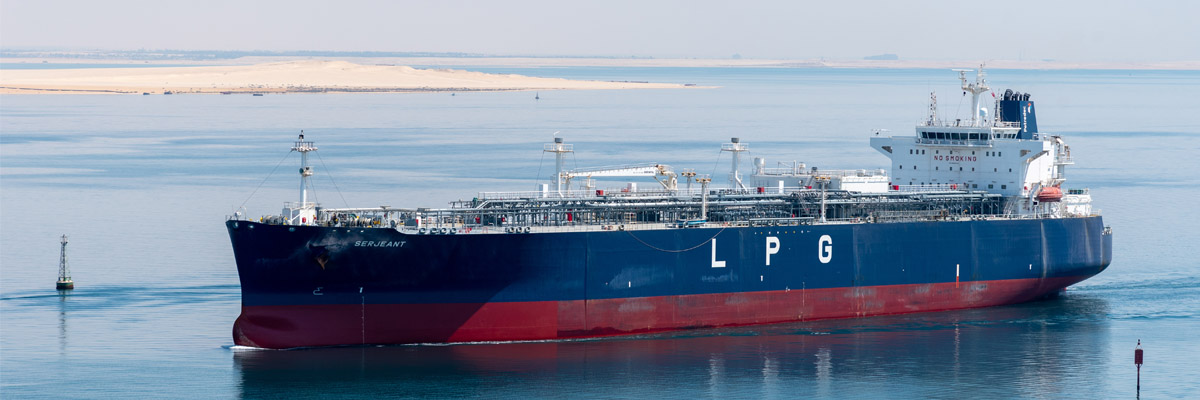
Houston-Chiba earnings reached their third-strongest week on record as Middle Eastern supply was again cut off and Panama Canal constraints tightened further
US supply fills the gap left by the Gulf
The Islamabad Memorandum, the US-Iran ceasefire signed in mid-June that briefly reopened the Strait of Hormuz, collapsed in early July after Iran resumed attacks on commercial shipping and the United States struck Iranian military infrastructure and reimposed its naval blockade. For the LPG market, the consequences were immediate. With roughly 30 percent of global seaborne LPG normally moving through the strait, the renewed closure has pushed Asian buyers back toward US Gulf supply, extending voyage distances and absorbing fleet capacity. VLGC spot earnings on the Houston-Chiba route reached their third-strongest week on record by the end of the month.
Canal constraints compound the tightness
Beyond the strait, the Panama Canal is emerging as an additional constraint on VLGC trade. The Canal Authority announced they may reduce daily transit capacity from 36 to 34 ships as water levels fall, with further cuts possible if El Nino, a Pacific weather cycle that brings drier conditions to Central America, reduces rainfall through the rest of the year. A large share of US LPG cargoes to Asia are already rerouting via the Cape of Good Hope to avoid canal congestion and elevated slot costs, adding thousands of additional miles to each voyage. Combined with the vessels still positioned outside or trapped inside the Gulf, effective fleet supply remains constrained from multiple directions. The one-year timecharter rate for an 84,000 cbm VLGC stands at approximately USD 66,000, reflecting confidence that these conditions will persist into the fourth quarter.
Structural tightness today, but a growing delivery pipeline ahead
The near-term picture remains strongly supportive, but the medium-term outlook is more balanced. Fleet expansion is expected to accelerate to roughly 7 percent in 2026 and peak at 16 percent in 2027 as VLGC and VLAC deliveries ramp up. Strong fundamentals have led older tonnage to sell for record prices, with a 2007 VLGC selling for $64m in July, a sale equivalent to a newbuilding price of about $248m, as per TradeWinds. This sale reflects how desirable it is to be a gas carrier owner in the current market conditions. The eventual reopening of the Strait of Hormuz, whenever it occurs, remains the single most significant catalyst for a normalisation of freight levels. Until then, the combination of strait avoidance, canal congestion, and strong US export volumes keeps the market structurally tight. The interplay between crisis-driven strength today and orderbook-driven supply growth over the next 18 months is the central tension for the segment.
Sources: Clarksons Research, MB Shipbrokers & TradeWinds